

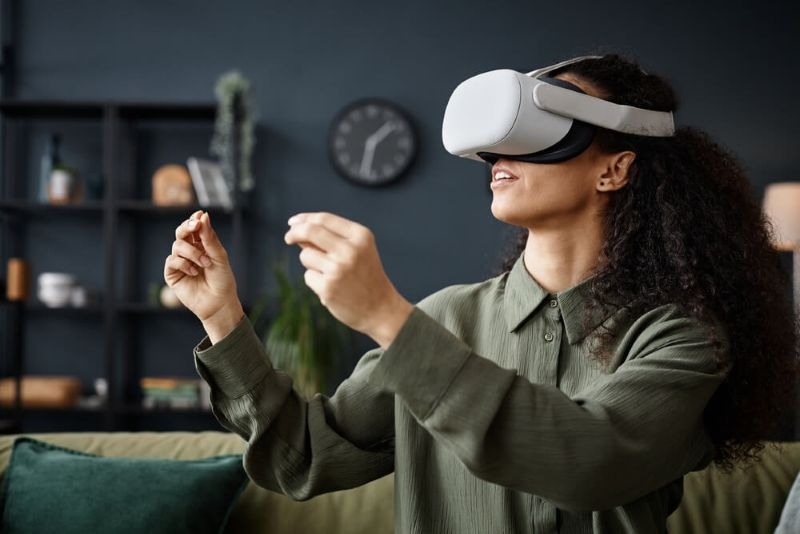
Technology trends come and go. Some flash bright and disappear. Others quietly slide into daily life until no one remembers how things worked before. augmented reality falls into that second category. It has moved beyond gaming headlines and tech conferences. It now sits in classrooms, shopping apps, factory floors, and even surgical rooms.
This guide breaks it all down. No hype. No confusing jargon. Just a clear look at how AR works, where it shows up in 2026, and why people keep talking about it.
At its simplest, what is augmented reality? It is a technology that overlays digital information onto the real world in real time. Instead of replacing your surroundings, it enhances them. A phone screen shows your living room. Then a virtual sofa appears inside it. You still see your room. You just see more.
People often confuse AR with fully immersive headsets. That is where the debate around AR vs VR comes in. Virtual reality places users inside a completely digital environment. Augmented reality keeps users grounded in reality while adding digital layers.
The distinction matters. One isolates. The other integrates.
And in 2026, integration wins.
Behind the smooth visuals sits a stack of complex systems. Cameras capture the environment. Sensors measure movement. Software maps surfaces and positions digital objects. Artificial intelligence interprets depth and lighting so virtual objects do not float awkwardly.
Still, users do not see that complexity. They see a simple interface. A product preview. A filter. Directions layered on the street.
That ease of use explains why augmented reality examples now appear everywhere. From scanning a restaurant menu to seeing animated 3D instructions for assembling furniture, AR quietly solves small, everyday problems.
The magic is not that it feels futuristic. It is that it feels practical.
The phrase AR technology 2026 is not just a marketing label. Several changes define this stage of evolution.
These shifts mean AR is no longer experimental. It is embedded. Quietly normal.
The growth of augmented reality applications is not limited to entertainment. Retail uses AR for virtual try ons. Healthcare uses it for surgical guidance. Manufacturing uses it for remote assistance and training. Education uses it to bring static textbooks to life.
Picture a student studying anatomy. Instead of staring at a flat diagram, she rotates a 3D beating heart floating above her desk. She zooms in. She explores layers. She understands faster.
Or consider a mechanic repairing complex machinery. AR highlights bolts in sequence. It reduces errors. It saves time. These are not experiments. They are operational tools.
And yes, augmented reality appears again in new forms as companies expand its reach into logistics, tourism, and real estate.
Check Out: Comparing Oura Ring vs Apple Watch for Health Tracking
Shopping changed dramatically once AR entered mobile apps. Customers no longer guess whether a chair fits their living room. They see it placed digitally in scale. They check color options in real lighting.
Beauty brands use AR mirrors for makeup previews. Eyewear companies let customers try frames virtually. It reduces returns. It builds confidence. Consumers appreciate control. They explore at their own pace. No sales pressure. The shift is subtle but powerful. Instead of imagining, users visualize.
The comparison of AR vs VR still sparks debate. Some argue VR feels more immersive. Others prefer AR’s flexibility. The difference lies in context.
VR excels in full simulation. Gaming worlds. Virtual training. Immersive storytelling. AR thrives when reality must remain visible. Surgeons cannot lose sight of a patient. Warehouse staff need awareness of their surroundings.
In 2026, businesses do not choose one blindly. They evaluate purpose. Practicality. User comfort. That balanced approach defines modern deployment.
Schools and corporations both leverage AR to shorten learning curves. Instead of reading instructions, learners interact with 3D overlays. A trainee electrician sees wiring diagrams projected onto actual panels. A medical intern practices procedures with step by step guidance floating in view.
Here, what is augmented reality becomes more than a definition. It becomes a tool for confidence building. Mistakes decrease. Engagement increases. Information sticks longer. It feels intuitive. That matters.
Healthcare demonstrates some of the most advanced augmented reality examples. Surgeons use AR overlays to visualize veins and organs beneath the skin. Physical therapists guide patients through exercises using digital prompts.
Remote consultations improve as specialists annotate real time visuals. A doctor across the country can guide a local practitioner through a procedure. Accuracy improves outcomes. Speed improves recovery. Technology does not replace professionals. It supports them.
Industrial environments benefit heavily from AR integration. Warehouses use smart glasses to guide picking routes. Maintenance teams receive real time diagnostics. In these scenarios, augmented reality applications reduce downtime and improve safety. Workers keep their hands free. They receive contextual instructions instantly. Efficiency increases without overwhelming users.
Looking forward, the direction is clear. AR will feel less like a feature and more like infrastructure. Invisible but indispensable. The second wave of AR technology 2026 development focuses on personalization. Systems adapt to user behavior. Interfaces adjust automatically. Digital content responds to context.
Privacy remains a concern. Data security matters. Companies must balance innovation with responsibility. Still, momentum continues. Investment grows. Adoption spreads across sectors. And the conversation around augmented reality keeps evolving as new tools emerge and expectations rise.
Read More: 5 Human Body Science Facts That Sound Like Science Fiction
Augmented reality in 2026 is no longer experimental. It is practical, accessible, and steadily integrating into daily routines. From classrooms to clinics to warehouses, its presence grows because it solves real problems. Not flashy. Just useful. And that quiet usefulness might be its biggest strength.
Augmented reality enhances real world environments with digital overlays. It improves understanding, efficiency, and interaction without replacing physical surroundings.
AR adds digital elements to the real world, while VR creates a fully digital environment. The choice depends on whether users need awareness of their surroundings.
Retail, healthcare, education, manufacturing, and logistics lead adoption. Businesses use AR to increase efficiency, reduce errors, and improve customer experiences.
This content was created by AI